ESCALATION system
The ESCALATION system is a series of clinical pathways for early recognition and response to paediatric clinical deterioration.
The system includes:
Paediatric Acute Response and Recognition Observation Tool (PARROT)

The PARROT consist of a suite of 5 charts for age ranges of less than 3 months, 3 – 12 months, 1-4 years, 5-11 years, and 12 years of age and over. There are 11 weighted (scored) variables that contribute to the calculation of a total Early Warning Score (EWS), which include:
- Family/clinician concern
- Respiratory distress score
- Respiratory rate calculated over 1 minute
- Oxygen saturation % (SpO2)
- Oxygen therapy score
- Heart rate calculated over 1 minute
- Blood pressure
- Capillary refill time
- Pain scale score
- Level of consciousness using AVPU (alert, voice, pain, unresponsive)
- Changing Behaviour (<1 year of age), New Confusion (>1 year of age)
Note: Whilst temperature is not included in the EWS, a baseline temperature recording is taken on admission and four hourly thereafter for an inpatient if within normal limits.
The Early Warning Score helps clinicians recognise patients who are acutely unwell or deteriorating. It guides them in taking appropriate clinical actions, as detailed in the Early Warning Score Escalation Pathway in the PARROT. The Early Warning Score is calculated at the time of a patient's initial presentation or admission and is updated as needed based on the patient's clinical condition.
As of September 2022, the PARROT Early Warning System has been implemented statewide across all WA Health hospitals, except for some remote Aboriginal Medical Services. The system is also being used by several private providers, including St John of God Hospitals, Ramsay Health Service, Kings Park Day Hospital, Waikiki Private Hospital, Esus Clinic, South Perth Hospital, West Leederville Private Hospital and various Urgent Care Clinics. Additionally, pre-hospital emergency response services such as St John WA and the Royal Flying Doctor Service are utilising this system.
PARROT v.5
The PARROT was updated to version 5 and implemented at Perth Children’s Hospital and other healthcare facilities in 2025 for several reasons. This included findings from the 2023 Safer Care for Children in Hospital Research Program, the development of the Sepsis Recognition Pathway in 2023, and recommendations from the Australian Commission on Safety and Quality in Health Care (ACSQHC). The ACSQHC recommendations emphasised that assessing new confusion or changes in behaviour should be considered a minimum standard for evaluating clinical deterioration.
Request to modify the paediatric ESCALATION system for your setting
To adopt and/or modify the ESCALATION system for your setting, please refer to the Work Instruction for ESCALATION System Modification Process.
This document outlines the steps to follow. Additionally, complete the ESCALATION Chart Request for Use or Change form to formally request modifications to the ESCALATION system in your setting.
ESCALATION resources
To support the implementation of the paediatric escalation system in your setting the escalation resources include:
Family Resources
A key component of ESCALATION is the incorporation of family input in reporting changes in their child’s condition that can indicate early signs of deteriorating health.
To support families to report changes they notice in their child’s condition, the Tell us if you are worried poster was co-designed with health consumers and is now displayed at patient bedsides in Emergency Departments and hospital wards throughout WA health facilities where children are cared for.
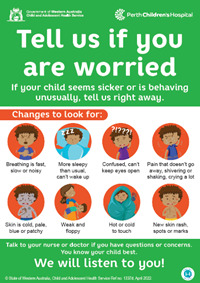
Download a copy of the Tell us if you are worried poster
Sepsis Pathway
Time is crucial in the effective treatment of sepsis so early recognition and escalation of care is vital.
To support clinicians in the hospital setting caring for children, the ESCALATION system includes a Paediatric Sepsis Pathway Trigger on the PARROT. This Pathway is used alongside Early Warning Score when measuring vital signs and other clinical observations. The Pathway includes guidance on when to consider sepsis, patients at higher risk of sepsis, and the response required.
If a patient requires a Sepsis Review, clinicians will then commence the Paediatric Sepsis Pathway.
The Paediatric Sepsis Pathway is a screening, escalation, assessment, and management tool, as well as a clinician decision-support tool. The document also contains guidelines for post-resuscitation care.
It identifies a child exhibiting signs of severe illness and empowers staff to escalate the case to a senior doctor who can then determine if it is sepsis.
Links to the sepsis resources are included below: