Status epilepticus
Disclaimer
These guidelines have been produced to guide clinical decision making for the medical, nursing and allied health staff of Perth Children’s Hospital. They are not strict protocols, and they do not replace the judgement of a senior clinician. Clinical common-sense should be applied at all times. These clinical guidelines should never be relied on as a substitute for proper assessment with respect to the particular circumstances of each case and the needs of each patient. Clinicians should also consider the local skill level available and their local area policies before following any guideline.
Read the full CAHS Emergency Department disclaimer
|
Aim
To guide staff with the assessment and management of status epilepticus. For seizures in neonatal patients please refer to Seizures Neonatal.
Definition
Convulsive status epilepticus is defined as a generalised tonic‐clonic convulsion lasting more than 5 minutes. or recurrent convulsive seizures without recovery between episodes.
However, we start to treat seizures as presumed status epilepticus using the following algorithm after 5 minutes of confirmed seizure activity, as treatment is most effective when started early.
Background
- Status epilepticus is the most common neurological medical emergency.
- In approximately 30% of cases, status epilepticus is the initial presentation of a seizure disorder.
- Mortality is 1-3%.
Risk
Treatment delay is associated with increased morbidity and mortality.
Key points
- The estimated incidence is 20 per 100 000 children per year.
- Treatment is most effective when started early.
Causes of Status Epilepticus:
- Prolonged febrile convulsion
- Epilepsy
- Central nervous system infection (e.g., meningitis)
- Neurosurgical (e.g., stroke, shunt, space occupying lesion)
- Trauma
- Metabolic
- Poisons
Assessment
History
- Description of the manifestation of the seizures obtained from the eyewitnesses (parent, carer, etc.,)
- Any impairment or loss of consciousness
- Motor effects, muscular contractions
- Parts of the body that are affected
- Focal or tonic / clonic seizure
- Length of seizure
- Multiple clusters of seizure activity
- Medication prior to arrival in hospital
- Infective Symptoms
- Developmental concerns
- Consider epileptic seizure mimics and alternative differentials
Examination
- Full systems examination including neurological examination.
- Examine for underlying causes that can precipitate seizures.
Investigations
- Always do a blood glucose level (BGL)
- ECG
- Venous blood gas
- Consider other investigations according to the possible underlying aetiology e.g., infectious screen, electrolytes
- Consider neuroimaging especially if focal features or traumatic
- Consider anti-epileptic drug levels if taking carbamazepine, phenytoin, phenobarbital or sodium valproate.
Management
The approach to a child who presents with a tonic-clonic convulsion > 5 minutes should be the same as for the child with established status epilepticus. This guideline addresses the treatment of status epilepticus and NOT the underlying cause – this should also be investigated and treated as required.
- ABC
- Consider airway adjuncts – oropharyngeal or nasopharyngeal airway as required.
- Oxygen
- Vascular access (and check BGL)
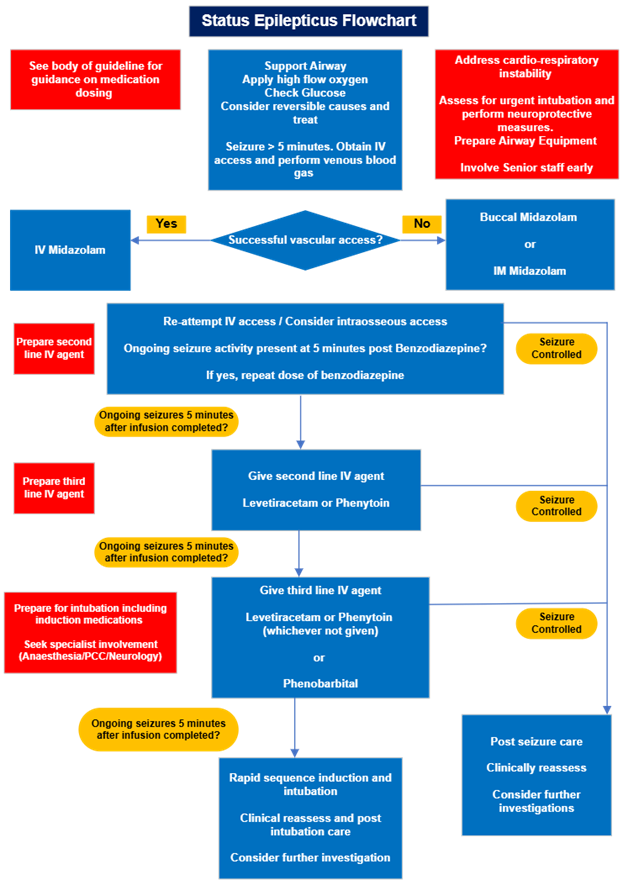
- Status epilepticus flowchart and medication formulary below
Nursing
- Follow the status epilepticus flowchart and prepare drugs as required.
- Any child having a prolonged seizure should be nursed in resuscitation room if possible.
- Baseline Temperature, heart rate (HR), respiratory rate (RR), oxygen saturation (SpO2), blood pressure (BP), Glasgow coma scale (GCS) and pupillary reaction. Continuous monitoring including cardiac telemetry should be used for patients with ongoing or prolonged seizures.
- If receiving anti-seizure medication infusions, increase monitoring frequency to every 5 minutes. Advise doctor immediately if any change in patients’ condition and slow/stop infusions if the patient becomes hypotensive, bradycardic or impaired respiratory effort.
- Prepare to insert 2 x intravenous cannula or intraosseous needles.
- Check BGL and inform doctor.
Most children recover responsiveness within 30 minutes after seizure cessation. Continue to monitor for further seizure activity and continue neurological observation every 30 minutes until GCS 15 whilst post-ictal.
Medication Formulary
See
Seizure Medication.
1. IV / IM / Intraosseous Midazolam6
- Dose: 0.15 mg/kg IV / IM / Intraosseous (max 10 mg)
- Dilution: Dilute IV / Intraosseous dose in sodium chloride 0.9% to give a final concentration of 1 mg/mL.
- Administration: Give IV preparations as a push over 2 minutes.
- Side Effects: Drowsiness, Hypotension, Respiratory depression.
- Monitoring: Minimum 15 minutely including HR, RR, SpO2, BP.
2. Buccal / Intranasal Midazolam6
- Dose: 0.3 mg/kg Buccal / Intranasal (max 10 mg/dose)
- Preparation: 5 mg/mL ampoules (undiluted)
- Suggested age-based doses:
- < 1 years: 2.5 mg Buccal
- 1 - 4 years: 5 mg Buccal
- 5 - 9 years: 7.5 mg Buccal
- > 10 years: 10 mg Buccal
- Side Effects: Drowsiness, Hypotension
- Monitoring: Minimum 15 minutely including HR, RR, SpO2, BP.
3. Levetiracetam7
- Dose: 40 mg/kg IV / Intraosseous (max 3 g)
- Dilution: Dilute dose in sodium chloride 0.9% to give a final concentration
of 50 mg/mL.
- Administration: Infuse over 5 minutes.
- Side Effects: Less likely to cause Respiratory Depression or Hypotension.
- Monitoring: 5 minutely including HR, RR, SpO2, BP for duration of infusion and for 30 minutes following completion of the flush. Slow or stop if hypotension, impaired RR or bradycardia.
- Levetiracetam is the preferred second line IV agent
- Dose: 20 mg/kg IV / Intraosseous (max 1.5 g)
- Dilution:
- Children ≤ 30 kg: dilute dose in 100 mL bag of sodium chloride 0.9%.
- Children > 30 kg: dilute dose in 250 mL bag of sodium chloride 0.9%.
- Not compatible with glucose or other drugs.
- Administration:
- Doses 1 g or less: infuse over 20 minutes.
- Doses above 1 g: infuse over 30 minutes.
- Check for crystals and use a 0.2 – 0.5 micrometre inline filter where possible.
- Side Effects: Hypotension, Thrombophlebitis, ataxia, rash
- Monitoring: 5 minutely including ECG, HR, RR, SpO2, BP for duration of infusion and for 30 minutes following completion of the flush. Slow or stop if hypotension, impaired RR or bradycardia.
- Dose: 20 mg/kg IV / Intraosseous (max 1 g)
- Dilution: Dilute to 20 mg/mL with water for injections.
- Administration: Infuse over 20 minutes.
- Side Effects: Hypotension, Respiratory Depression.
- Monitoring: Continuous HR and SpO2 for duration of infusion and 30 minutes following the infusion. 5 minutely observations in addition including RR and BP for duration of infusion and for 30 minutes following completion of the flush. Slow or stop if hypotension, impaired RR or bradycardia
- This is the preferred medication in neonatal status epilepticus
References
- AMH Children’s Dosing Companion. A-Z Medication Monographs. Australian Medicines Handbook Pty Ltd. [Cited 26 May 2026]. (Available via CAHS library)
- Dalziel S, Borland M, Furyk J, Bonisch M, Neutze J, et al. Levetiracetam versus phenytoin for second-line treatment of convulsive status epilepticus in children (ConSEPT): an open-label, multicentre, randomised controlled trial. The Lancet,\. [Internet] 2019. [Cited 26 May 2026]. Available from: doi.org/10.1016/S0140-6736(19)30722-6
- Lyttle M, Rainford N, Gamble C, Messahel S, Humphreys A, et al; with support of Paediatric Emergency Research in the United Kingdom & Ireland (PERUKI) collaborative* Levetiracetam versus phenytoin for second-line treatment of paediatric convulsive status epilepticus (EcLiPSE): a multicentre, open-label, randomised trial. The Lancet. [Internet] 2019.[Cited 26 May 2026]. https://doi.org/10.1016/S0140-6736(19)30724-X
- Wilfong A.. Management of convulsive status epilepticus in children. UpToDate: Wolters Kluwer/ [Internet] Updated Sept 2024. [Cited 26 May 2026]. Available from: Management of convulsive status epilepticus in children - UpToDate
- Advanced Paediatric Life Support. Management of Status Epilepticus. [Cited 26 May 2026]. Available from: Algorithms | Status epilepticus
- AMH Children's Dosing Companion. Midazolam. Jan 2026. [Internet]. [Cited 26 May 2026]. Available from: https://childrens-amh-net-au.pklibresources.health.wa.gov.au/monographs/midazolam
- AMH Children's Dosing Companion. Leviteracetam. Jan 2026. [Internet]. [Cited 26 May 2026]. Available from: https://childrens-amh-net-au.pklibresources.health.wa.gov.au/monographs/levetiracetam
- AMH Children's Dosing Companion. Phenytoin. Jan 2026. [Internet]. [Cited 26 May 2026]. Available from: https://childrens-amh-net-au.pklibresources.health.wa.gov.au/monographs/phenytoin
- AMH Children's Dosing Companion. Phenobarbital. Jan 2026. [Internet]. [Cited 26 May 2026]. Available from: https://childrens-amh-net-au.pklibresources.health.wa.gov.au/monographs/phenobarbital
Bibliography
- Chin RF, Neville BG, Peckham Cet al. Incidence, cause, and short-term outcome of convulsive status epilepticus in childhood: prospective population-based study. Lancet 2006; 368: 222–9.
- Carey JM, Shah MI. Pediatric prehospital seizure management. Clin. Pediatr. Emerg. Med. 2014; 15:59–66.
- Raspall-Chaure M, Chin RF, Neville BG, Bedford H, Scott RC.The epidemiology of convulsive status epilepticus in children: a critical review. Epilepsia. 2007;48(9):1652.
- Raspall-Chaure M, Chin RF, Neville BGR, Scott RC. Outcome of paediatric convulsive status epilepticus:a systematic review. Lancet Neurol. 2006; 5: 769–79.
| Endorsed by: |
Drug and Therapuetics Commitee |
Date: |
Jul 2026 |
This document can be made available in alternative formats on request for a person with a disability.